

ALGAR DO CARVÃO OPENING SEASON
Algar do Carvão was closed to visitors for some time due to the construction of the new Visitor Centre.
Since March, visits have resumed, although the final phase of construction works at the Visitor Centre is still underway. Therefore, special visiting conditions apply.
All visitors must be properly informed about these conditions and must strictly comply with all the established rules, as outlined below.
Visits to Algar do Carvão may be temporarily suspended whenever certain construction works or procedures require it. These temporary closures will be for short periods and will be announced in advance on this page.
OPENING DAYS AND SCHEDULES
- MARCH 21 st until 31st: TUESDAYS, WEDNESDAYS, FRIDAYS AND SATURDAYS – 2:30pm until 5:00pm
- APRIL and MAY: EVERY DAY – 2:30pm until 5:00pm
- JUNE, JULY, AUGUST and SEPTEMBER: EVERY DAY – 2:00pm until 6:00pm
- OCTOBER, NOVEMBER and DECEMBER 31st:TUESDAYS, WEDNESDAYS, FRIDAYS AND SATURDAYS – 2:30pm until 5:00pm
TICKETS & PAYMENT
- No reservations are required, tickets can only be purchased upon arrival. There are no online reservations, advance purchases, or group rates.
- Payment methods: Cash, Debit Card, and Credit Card (except American Express).
- Admission price per person: Algar do Carvão 10,00€ (there are no Combo Tickets Algar do Carvão + Gruta do Natal)
THE CAVE WILL BE CLOSED ON TOLERANCE DAYS: Carnival Tuesday | December 24th | December 31st
GENERAL INFORMATIONS
- The ticket office at Algar do Carvão is a temporary facility intended exclusively for ticket sales.
- There is no souvenir shop or café/bar on site.
- There are no sheltered areas, restrooms, or rest areas available at the site.
- There will be Montanheiros staff inside the cave and visitors may request guidance or explanations about the genesis of this volcanic pit, with no additional cost.
- The visit lasts approximately 30 minutes.
OPENING DAYS AND SCHEDULES
- Ticket sales and admissions are processed during hours established by the Board of Directors.
- Opening days and visiting hours are displayed at the entrance of the temporary ticket office at Algar do Carvão, as well as on the official website (www.montanheiros.com) and official Facebook page.
- Opening hours and days are subject to change without prior notice.
- The right to deny entry after closing time is reserved, even for those with combined tickets.
CAPACITY & QUEUE MANAGEMENT
- A single queue system will operate on a first-come, first-served basis, and delays are expected due to the current exceptional visiting conditions and due to the high demands.
- No priority is given for organized groups or free admission groups.
- Maximum capacity inside the site is 150 people (this number may be reduced).
FREE ADMISSION
Eligible for free admission:
– Montanheiros members with regularized membership fees (entitled to one guest).
– Children under 12 years of age accompanied by a paying adult.
– Local tour guides on duty.
– Holders of a card or official certificate of disability.
Free admission conditions:
- The maximum number of free admissions is 50 people per day.
- Free admission groups must submit a visit request at least 48 hours in advance (approval is subject to availability and operational constraints).
- Priority is given to Azorean organizations like schools (except higher education), support centers for the elderly or disadvantaged people, after-school activity centers (ATLs), scout groups, and fire departments.
- Family members accompanying these groups are not eligible for free admission.
- Other requests for collaboration will be reviewed and considered individually, the decision will always be made by the Board of Directors of the Association.
DISCOUNTED ADMISSION
The following are entilted to discounted admission:
– Membership card holders of Blood Donors Association of Terceira island benefiting from an approximately 20% discount.
SAFETY & PHYSICAL CONDITIONS
- Visitors must follow the designated route from the temporary reception/ticket office to the tunnel which accesses the cave
- Relative air humidity is always very high (above 90%), so there is constant dripping inside the cave.
- The floor inside the cave is fully cemented. To reach the main platform, visitors descend two tunnels with a total of 114 steps. Additional steps connect to other platforms, bringing the total to 338 steps.
- Not recommended for: people with physical limitations, balance problems, claustrophobia (if applicable, this should be reported at reception), babies or toddlers, or women in advanced stages of pregnancy.
- Appropriate footwear and clothing are advised (sneakers, boots, hiking gear).
PROHIBITED
– Leave the designated visitor route in areas where construction work is taking place.
– Leave the designated route inside the cave. Climb the walls or descend to the lagoon.
– Collection/destruction of geological samples
– Leave litter inside the cave
– Use of tripods (except with prior and timely authorization from the Montanheiros Board of Directors).
– Smoking and eating inside the cave.
– Entry with animals is prohibited without exceptions.
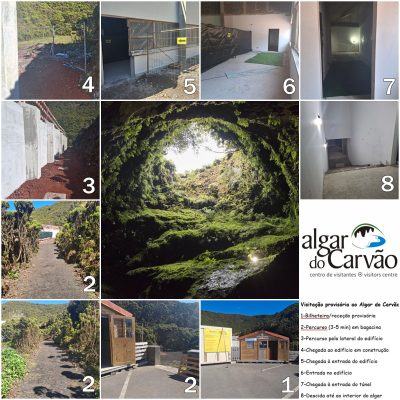
1 – Temporary ticket office/reception | 2 – Route (3–5 min) on volcanic gravel | 3 – Path along the side of the building | 4 – Arrival at the building | 5 – Arrival at the building entrance | 6 – Inside the building | 7 – Arrival at the tunnel entrance | 8 – Descent into the interior of the cave
ASSISTANCE
- In case of doubt, visitors should seek clarification at reception or with the Montanheiros staff inside the cave.
CONTACTS
ENTRIES ON CREDIT (Send prior info: Tax number | Address | Group Names | File or Voucher number | Paxs):
INFO | SPECIAL VISITATIONS REQUESTS | AUTHORIZATIONS:
The great eruption, known as “do Pico Alto”, which occurred north of the existing Guilherme Moniz volcanic apparatus, spilled its lava a great distance away. Later, a new eruption, this time basaltic, tore through the ground and began a process that would lead to the formation of a strombolian volcano – The Pico do Carvão. In a first phase, by forcing and trying to break the trachyte spill, already existing and constituting a natural barrier of not very “cooperating” consistency, it formed the lagoon area and the two vaults over it. Later, in a new attempt to escape, the basaltic lavas broke through the current chimney to the outside. In its final phase, the magma descended into the deeper chutes and the magma chamber, giving rise, this almost instantaneous absence of magma, to the formation of the Algar itself.
The very effusive lava flows produced rivers of very fluid acidic lava that charred existing vegetation. The dating of one of the fossils formed then, gives Algar do Carvão an age of 2148 (+ or – 115 years).
Location
The volcanic cone, that lodges Algar do Carvão, is located sensibly in the middle of Terceira island, north of the city of Angra do Heroísmo, about 12 km away by road.
The access is easy, using the public road network that has sufficient signaling for the effect. It has a geographical position of coordinates 38°43’41.54 “N 27°12’59.01 “W and an elevation of approximately 640 m.
The First Descents
The first known account of a descent to Algar do Carvão dates from January 26, 1893, with the use of a rope, carried out by Cândido Corvelo and José Luís Sequeira. A second descent was made by Didier Couto, in 1934, who drew up the first profile of the Algar.
Only on August 18, 1963, organized descents into the interior of the Pit began, by a group of enthusiasts, who later would organize themselves into an association called “Os Montanheiros”, using a more elaborate system. With recourse to more efficient portable lighting systems, it was possible to progress in the Algar in order to explore it until the remotest and tiniest hole. With the collection of elements fallen on the ground it was possible to bring to daylight and to everyone’s eyes a sample of some of the materials that make up the cave.
After the first descents, and with the patrimonial value that they had recognized in this cave, they decided that something so beautiful and rare should be shared with many others. The system of descent, through the mouth of the Algar, did not make this task feasible, as it took almost a day to get 6 to 8 people down and up. Even so, many were the expeditions carried out for this purpose, and on weekends they moved dozens of people each time.
A more functional solution, to take the people interested inside Algar, was however in sight.
The Tunnel and the Stairs
With the Montanheiros already constituted, topographical surveys were done for the opening of a tunnel, in order to allow easy access for those who wanted to visit and study this Algar.
Beginning on May 28, 1965 and running until November 28, 1966, on weekends and holidays, the Montanheiros were able to tear a 44-meter tunnel into the interior of the algar, which was later enlarged and consolidated in concrete.
Staircases were built inside, initially in wood to allow access to the lower part of the algar. Several acts of vandalism totally destroyed these interior stairs. Later, in 1977, the current concrete staircase was built, with a total length of 300 meters, repaved and extended in 2003.
Algar’s Donation
The value and merit that the Associação Os Montanheiros showed throughout this long period of expeditions to the Algar, namely with the opening of the tunnel and the construction of the road, did not go unnoticed by the owner of the land, with whom the Montanheiros had a friendly relationship, and who had verbally authorized all these actions. It is therefore not surprising that on November 30, 1973, a portion of that land, which sheltered the tunnel, was donated by José Ataíde da Câmara and his wife to the Montanheiros. The strip of land, where the Montanheiros had torn off the access, was also donated, deriving from the Caminho do Cabrito, which facilitated the arrival at Pico do Carvão and which has now become a public domain path.
Geological interest
Not infrequently the interior of our volcanic cavities has beautiful natural scenery. In this respect Algar do Carvão is the most expressive example in the Azores.
It is a remarkable volcanic chimney, which unlike what usually happens in other cases is not completely blocked. With a 15 X 20 meters crater it ends 90 m down in a clear water lagoon.
As the water seeps through the rocks and slag, it dissolves and is enriched in ferric and silica minerals. As it is released, precipitating into the lagoon, it deposits minerals in the form of milky white amorphous silica stalactites and stalagmites or reddish ferric veins in the vaults, interior walls and floors, some producing, by oxidation, limonite deposits. This fact makes the two innermost vaults distinct: on the lagoon the silica predominates and on the “stage” the ferric deposits predominate. It has also been advanced the hypothesis that the siliceous formations are related to the presence of diatoms, which have silica in their structure.
It is also possible to observe some basalt layers that manage to remain coalescent to the trachytic walls; black enameled formations covering some walls or forming hanging blades; lava flows that occurred before the total solidification of the lava or by refusion mechanisms of the walls.
The lagoon with a surface of at most 400 squared meters, fed by rainfall infiltration and some small springs immersed in the lagoon, reaches a maximum depth of 15 meters. In low rainfall years it dries up almost completely. A fossil of a seabird perfectly preserved and covered with silica was found at the bottom of the lagoon. This lagoon, with the other formations of the cave that surround it, brings an additional beauty to the whole.
Because of what it can be observed and the questions it raises, its geological importance has been noted by several national and foreign specialists.
Algar do Carvão is a site of geological interest, being a geosite of the Azores Geopark (https://www.azoresgeopark.com/ ) and was a finalist in the “7 Maravilhas Naturais de Portugal” (7 Natural Wonders of Portugal) contest.
Fauna and Flora
The beauty of this Algar is also shown in the vegetation that covers the interior of the cone, which is a very characteristic habitat – a volcanic chimney. The light intensity always reveals itself as a limiting factor to the distribution of plant species. Although the plant communities develop up to about 64 meters below the mouth, life nevertheless fills the entire cave, with the presence of algae and molds.
On the perimeter that surrounds the “mouth” of the creek, we have a tree community composed of species such as Ilex perado, Erica azorica, Laurus azorica, Vaccinium cylindraceum, some ferns such as Blechnum spicant, Polypodium macaronesicum, Culcita macrocarpa and Elaphoglossum hirtum along with several bryophytes, mostly epiphytes on the tree/shrub species found here. Then we move to a herbaceous stratum, with Lysimachia azorica, Hedera helix, several Carex, Leontodon rigens, Luzula purpureo-splendens and Prunella vulgaris. Again several species of mosses and liverworts are present. In a lower area we have only ferns and some bryophytes. Biodiversity drops considerably. Finally, in the penumbra, only diatom algae and chlorophytes and molds remain.
In terms of vertebrate fauna, it is possible to observe different birds that seek refuge here. A night visit provides a good opportunity to observe birds such as the sparrow (Passer domesticus), the blackbird (Turdus merula azorensis) and the chaffinch (Fringila coelebs). Occasionally rabbits are observed inside the algar, killed as a result of falling through the crater. There are no records of rats, bats or any other vertebrates. However, at the level of cave arthropods, the Algar possesses a considerable wealth, with several troglobic species identified.
Social Manifestations
The search for new stages, with exotic scenery, was perhaps the main reason that very varied social activities have been held at times in the past.
The algar has already seen, on public display, the performance of several choral groups and popular music groups, as well as the celebration of Eucharist inside.
We can also mention that several times this space was the target of attention of television producers of different nationalities, in order to make reports and documentaries.
Visits to Algar do Carvão
It is possible to visit Algar do Carvão under special visitation conditions during the final stage of construction of the new visitor center. However, Algar do Carvão may temporarily close for short or long periods of time as required by specific stages of the construction work
Tripadvisor Certificate of Excellence 2014
ALGAR DO CARVÃO
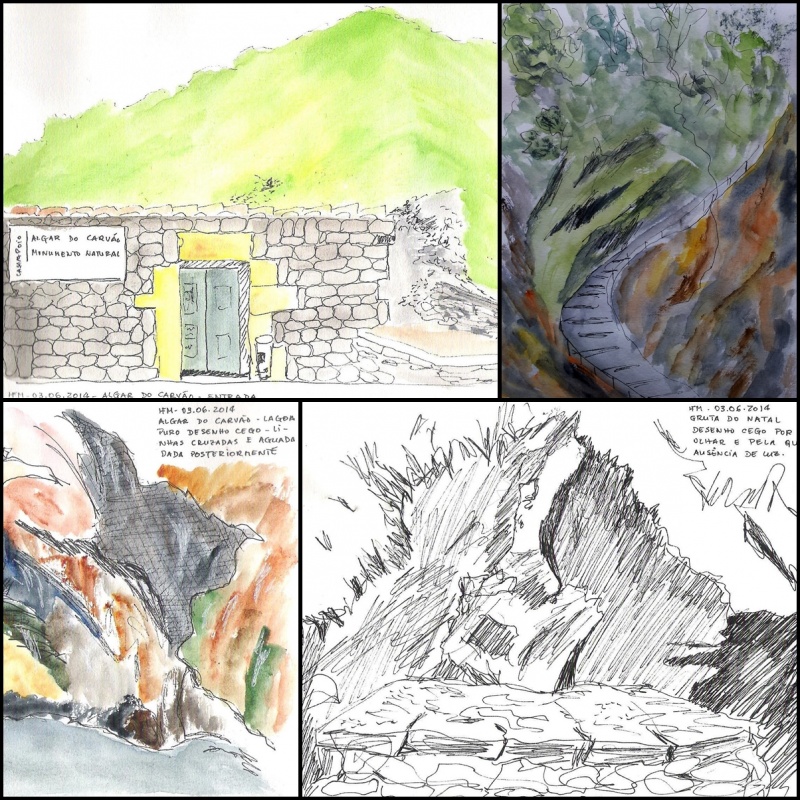
An urban sketcher’s view of Algar do Carvão and Gruta do Natal, by Helena Monteiro
1 jun 2014